BioProNET meetings ignite collaborative project on biologic production

Professor Ian Stansfield from the University of Aberdeen has recently been awarded funding
for a collaborative project investigating how to optimize the production of biologics, which was catalyzed by his participation at BioProNET events.

The production of vaccines, antibodies and other proteins in cell lines can induce cellular stress, which can lead to errors in translation — including ribosome frameshift errors. Such mistranslation can compromise the yield and quality of the protein product, and hence the safety and efficacy of biologics. Ian’s project will pursue a better understanding of causes of translational error through the design and application of novel reporters of mistranslation.

“Initial discussions on this project were started as a result of the BioProNET sandpit meeting, held in June 2015, when I made initial contact with a scientist from the biotechnology company Fujifilm Diosynth Biotechnologies,” says Ian.

As a result of this networking meeting, Ian co-organized a BioProNet-sponsored workshop on recombinant protein authenticity, together with colleagues Mick Tuite and Tobias von der Haar from the University of Kent. Ian commented “The attendance of scientists from Fujifilm at our BioProNET-sponsored workshop in London consolidated ideas for the project”.

The project includes collaboration partner Professor Phil Farabaugh, a molecular biologist from University of Maryland, USA, and physicist Dr Mamen Romano (University of Aberdeen) who will be mathematically modelling gene expression processes. Ian’s group will then use synthetic biology approaches to  couple the output from the new mistranslation sensors to recombinant protein expression, in order to autoregulate mistranslation and the quality of the recombinant protein product.

Fujifilm will test these synthetic gene circuits in in yeast and E.coli to maximise the impact of this research on industrial biotechnology.

More about the project, which is jointly funded by the BBSRC (to Ian Stansfield and Mamen Romano) and the US National Science Foundation (to Phil Farabaugh) can be found here.

Joint NIBB meeting – overcoming cellular barriers

FullSizeRender

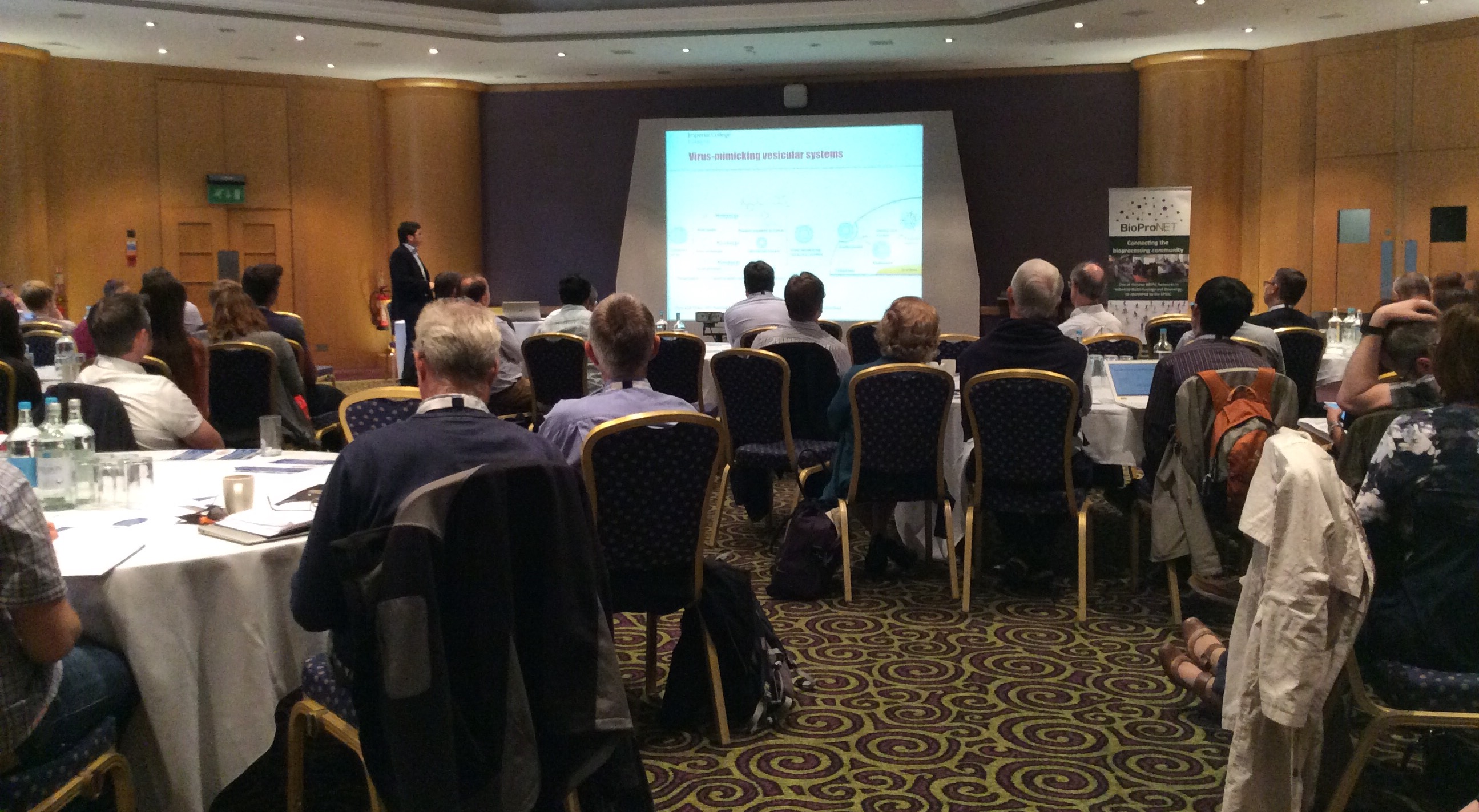
Over 75 BioProNET, BioCatNet and CBMNet members attended this joint NIBB (networks in industrial biotechnology and bioenergy) event, held on July 6th & 7th 2016 in Birmingham. After an introduction outlining the objectives of the event, attendees completed a ‘me profile’ describing who they were, their expertise, their dream project and what the next big development in their field of research could be. This was followed by a series of talks from academics and industry scientists in 3 sessions:

Protein trafficking in eukaryotic cells
Protein export from bacterial cell factories
Delivering therapeutic proteins and other compounds
Attendees then spent the rest of the day formulating potential project ideas and developing these new collaborations. This was then followed by a conference dinner where further networking took place, together with some football watching! The second day focused on ‘technology drivers’; after two talks attendees then moved into to groups to further develop project ideas. At the end of day two, 9 project ideas were generated and champions assigned to take these projects forward.
 

New Protein Solubility Predictor Funded by PoC Award

Proof of Concept funding from BioProNET has enabled Jim Warwicker and colleagues from the University to build a webtool that predicts protein solubility. Recombinant biologics often have low solubility, due to their high concentrations, sequence and three-dimensional structure. The accumulation of insoluble protein agglomerates can lead to the formation of aggregates, which can impact biological activity and immunogenicity of a biologic.

Therefore determining the solubility of a protein and its propensity of a protein to aggregate would be of great use to the biopharmaceutical industry and researchers.

The funding from BioProNET enabled Jim and colleagues to develop existing code into a user-friendly web format. Users (anyone!) can paste a single sequence of amino acids into the tool; the software compares this sequence to a benchmark dataset of proteins with known solubility, and then returns a set of calculations that predict solubility of the protein based on its sequence.

The programme calculates a variety of properties — such as amino acid composition, net predicted charge, predicted pI value, ratio of conservative amino acids, propensity for disorder, propensity for forming beta strands and sheets — that indicate how soluble the entered amino acid sequence is likely to be.

The webtool is available here:
http://www.protein-sol.manchester.ac.uk/

The project is already bearing fruit, as it has been used as part of a successful proposal to the EPSRC formulation call. The software is still under development and further improvements, including those based on user-feedback will be added.

Protein-Sol: A web tool for predicting protein solubility from sequence
Hebditch M, Alejandro Carballo-Amador M, Charonis S, Curtis R, Warwicker J.
Bioinformatics doi: 10.1093/bioinformatics/btx345 May 29 2017

3rd Annual Scientific Symposium

October 19–20th 2016, East Midlands Conference Centre

Thank you to everyone who attended our 3rd annual science meeting and contributed to its success. A pdf of the conference booklet is available here.

img_4055

Congratulations to our prize-winners:
Poster prize first place: Tim Eyes (University of Manchester)
Poster prize second place: Ilokugbe Ettah (Lancaster University)
Poster prize third place: Ben Dolman (University of Manchester)
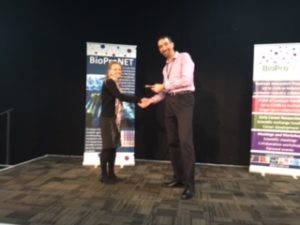
Early career talk prize: Sarah Hedberg (Imperial College London), pictured

Programme

Day 1
Keynote speaker William Barton (Virginia Commonwealth University, USA) Over-expression of secreted proteins from mammalian cell lines

2016 early career researcher event

BioProNET early career research event 2016
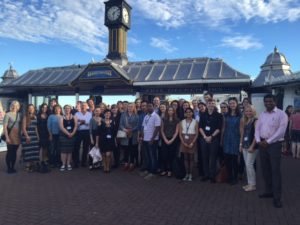
September 6–7th Brighton Mercure Seafront Hotel

Many thanks to everyone who made this event a sucess!

img_3638

The programme for the 2016 event reflected feedback from delegates at last year’s highly successful meeting; delegates said they wanted more time to focus on CVs, cover letters, being interviewed (and interviewing) and preparation for job applications, as well as presentation skills. The facilitators and presenters at this year’s event had considerable experience of recruiting for bioprocessing- and indistrial biotechnology-related careers.

We were pleased to welcome Martin Popplewell and his team from Coconut Communications to this event to deliver the media training sessions. Martin has more than 25 years of experience working in journalism, including at the BBC, Sky News and ITN.

In the media training session, delegated worked in small groups (6 people) with a trainer in a practical session where they prepared for an interview, were interviewed and then received a personal review and critic of their performance.  They will have two interviews, allowing them to learn and improve, and they received receive a copy of their interviews and a booklet covering the theory of good media interviews.